
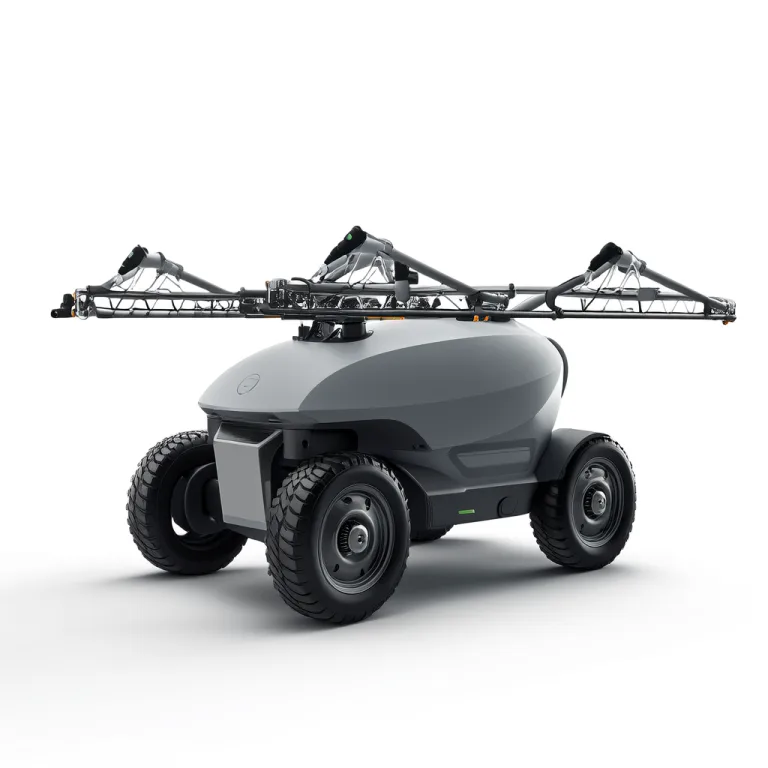
Autonomous Orchard Sprayer
Autonomous Orchard Sprayer for industrial applications.
About Autonomous Orchard Sprayer
Autonomous Orchard Sprayer for industrial applications.
| Domain | agritech |
|---|---|
| Product Family | Spraying Equipment |
Who Works With Autonomous Orchard Sprayer?
5 engineering roles are connected to Autonomous Orchard Sprayer based on verified research evidence.
Autonomous Systems Engineer
Autonomous Vehicle Engineer is a widely recognized engineering role in robotics and agritech, focused on perception, planning, and control systems — directly applicable to the Autonomous Orchard Sprayer. While 'Autonomous Vehicle Engineer' is commonly used in job postings (e.g., John Deere), the canonical, domain-agnostic professional title is 'Autonomous Systems Engineer', which better reflects the broader discipline beyond road vehicles and aligns with IEEE/INCOSE taxonomy. The role is not product-specific (i.e., not 'Orchard Sprayer Engineer'), so product_specific_title = false. Evidence confirms involvement in designing and validating autonomous functionality for agricultural machinery including sprayers.
Robotics Software Engineer
Robotics Software Engineer is a widely recognized professional role in industrial automation and agritech; 'Senior' denotes experience level, not product-specificity. The role directly designs, develops, and tests the autonomy stack (3D canopy mapping, variable-rate logic, fleet coordination) for the Autonomous Orchard Sprayer — core engineering functions. While applied to an agritech product, the title itself is domain-general and standardized in IEEE/ACM and industry job taxonomies.
Field Applications Engineer
Field Applications Engineer is a well-established engineering role bridging technical product expertise and customer application needs. The modifier '– Autonomous Agriculture' denotes domain specialization, not a distinct profession. In the context of the Autonomous Orchard Sprayer, this role directly supports deployment (INSTALL/COMMISSION), real-world operation (OPERATE), integration troubleshooting (TROUBLESHOOT), validation in field conditions (TEST), and contributes to requirements for autonomy enhancements (SPECIFY). The role is distinct from sales or pure R&D and has recognized industry usage (e.g., in semiconductor, robotics, and agritech sectors).
Robotics Engineer
Robotics Engineer is a widely recognized professional engineering role in automation and industrial robotics domains; the evidence explicitly states they design, build, test, and deploy robotic systems—including industrial robots—and collaborate with operators/technicians for reliability and efficiency.
Systems Integrator
A 'Systems Integrator' is a widely recognized professional role in industrial HVAC and automation contexts, responsible for integrating components (e.g., air receiver tanks) into larger control and pneumatic systems — including interfacing with compressor controls, pressure sensors, isolation valves, and SCADA/PLC systems. The evidence confirms commissioning responsibilities involving integration with compressor controls and system-level verification, aligning directly with the core function of a Systems Integrator.